
Twin Portraits
Photo credit © Marge Rendell
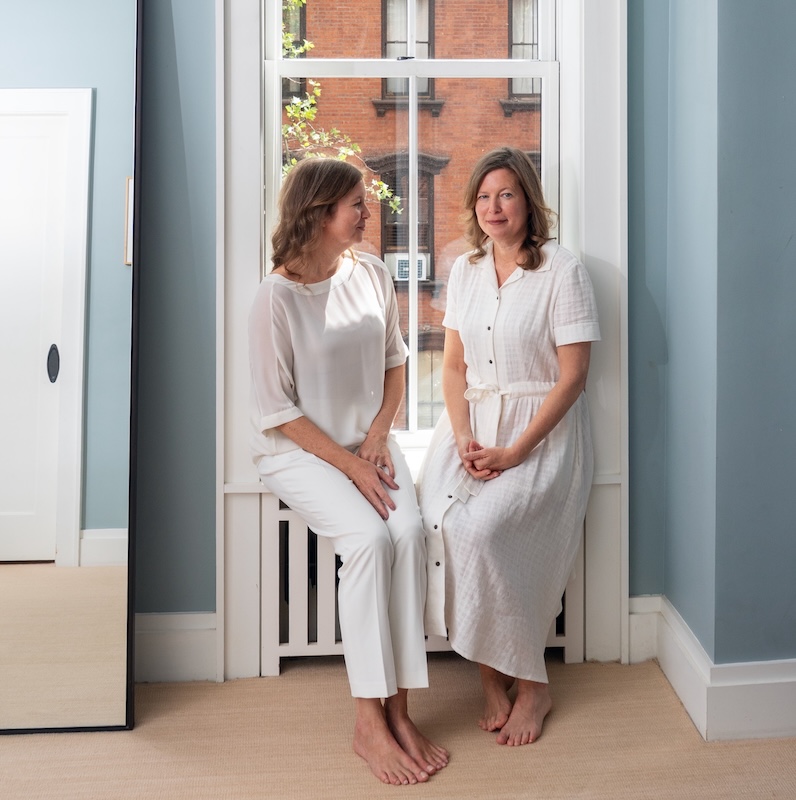
Karen said, “It would be hard to be the photographer, with twins as the subject.” We were bumping around in my kitchen, drinking coffee we didn’t need, murmuring about the photo shoot that had just wrapped up. I almost always know what Karen means without her having to elaborate. I nod, “Hmm-mm.” But this time I wanted to know more.
“In what way?”
“There’s no single focus. Or there’s two, side by side. It's different in a normal portrait, one on one.”
The photographer had given us limited direction, which was genius because, even though my face (and Karen’s) froze as it always does when having its picture taken, my body, left to its instincts, fell naturally into place beside hers. My head tilted in without having to be told. My left palm floated to her shoulder, while my right hand held her left in a kind of relaxed couples’ dance. We hardly knew it: the whole experience—taking away the faces—happened without our bodies “thinking” anything at all. They just did.
Our bodies blur when they are side by side. They always have. It truly is a relief standing next to my twin (something I don’t get to do often and haven’t for a long time, since we live so far apart). In those moments I get a break from being a singular container, a solid entity. I get to disappear.
I’d arranged the shoot after the same photographer came to my house on a rainy day the previous November to take my author photo, which I loved. Karen would come to New York in April for the AIPAD photo fair, as she always did for work. We planned this “twin photo shoot” then.
Now it was April, and the photographer, magically, intuited the subject we stepped into. That is, the “twin” subject. This is something twins themselves don’t know all that much about actually, not consciously. They are it. It’s the experience of being something that cannot be easily articulated. Like so many experiences, this one doesn't have many words. But I’ll try anyway.
I’ve always wondered why so many novels featuring identical twin characters are not written by identical twins themselves. Why haven’t more twins written about the twin experience in fiction? It certainly appears in all kinds of books and always has. Twins are fascinating. But, maybe they are fascinating in a very different way to twins themselves.
I, for one, am less fascinated by the likeness thing, the differentiation thing—the finding what is the same and what is different. This is usually done in the faces of identical twins. I’m also less fascinated by the fact that we shared a womb and that one of us came out first (the most common question: “Which one was born first?”). All of these things I take for granted. I virtually do not know what it’s like not to look like someone else or to have shared a womb or to have been born two minutes before Karen. These things don’t fascinate me because I don’t, and never will, know any differently.
What does fascinate me is that Karen is always there, in me. She is in all ways a physical part of me. The cells that make up our bodies came from the same blueprint. I carry her around with me in New York just as she carries me around with her in London. Which explains why, when we stand side by side, there is little boundary. Our cells are happy to “see” each other again, having been split apart for some time but still part of each other. I imagine the skin cells along my left arm surging with gladness next to those on her right shoulder, my arm floating into position, palm settling like an afterthought. Click. The side of my head sidles up to hers and whispers, Nice to see you!—those hair cells and brain cells and blood cells and nerve cells—So happy to be with you again! Click.
Blending. Two into one but not at all. Two into two that were one once, but not anymore. That's the photographer's subject. The twoness that is a oneness, but not one thing at all.

Photo credit © Marge Rendell
Forty-eight years ago, when we were three, Karen and I were taken to a portrait studio in downtown Galesburg, Illinois. It was the middle of summer, hot and humid, just how we liked it. We were on our yearly two-week visit with our grandparents. We were with our mom. Our brother was either back at the house or off camping or bike riding with the cousins and aunts and uncles who also came and went during that annual family visit. Our grandfather was still working as a surgeon at the hospital, and normally we would be accompanying our grandmother on her Meals on Wheels rounds, or driving out to neighbors’ farms for fresh corn and strawberries. But today, we were having our picture taken by a professional photographer, our grandmother’s friend.
I don’t remember the photographer clearly. What comes to me in glimpses is his studio: a dim (probably because it was so hot outside) dressing room, where we were put into dresses the photographer had designed for us: both the color of cream and in different styles but the same length, above the knee. My dress had puffy three-quarter-length sleeves. Karen’s had long, straight sleeves to her wrists. My dress billowed a bit from a sinched crewneck. Karen’s fell like a tunic, a faint silken stripe in its fabric. We wore identical opaque cream tights and no shoes.
Karen and I examined each other’s dresses, this much I remember, while our mom brushed our hair. We must have had some makeup put on because in the finished portrait our lips shine. And our faces in that photograph don’t tighten at the jawline. I can tell that rather than clenching my teeth they are slack, my tongue too. We look thoughtful, even serious. We look directly at the photographer with absolutely no problem whatsoever. I do have faint, very faint, glimpses of myself next to my sister, my left arm lifted so that my palm rests on her shoulder, my right hand clasped and hardly felt in hers. That’s the portrait taken when we were three. Forty-eight years ago.
Those faces have changed quite a bit—to think of what has happened in our lives since is insane: all the good and all the bad—but the bodies come together exactly as they did then. Those faces in April show more than aging: they show the years of worry and anxiety, of success and failure, of having children and of not having children, of heartbreak and loneliness, of pride and joy. The years.
And yet. She was there for all of them. I was there for all of them, too.
One life? No, two lives lived side by side. Two that is one and not one. Twoness that is oneness but not one thing at all.
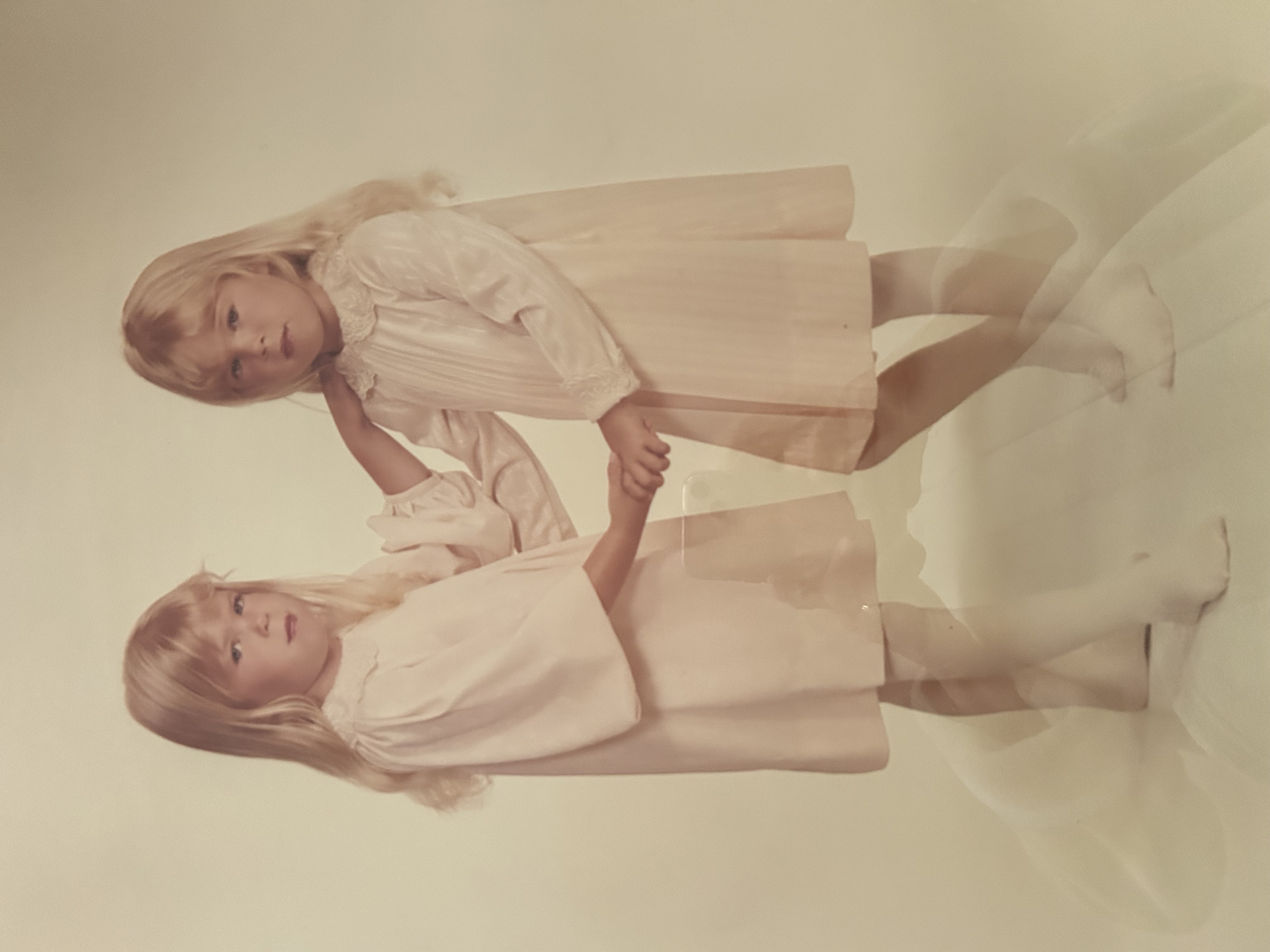
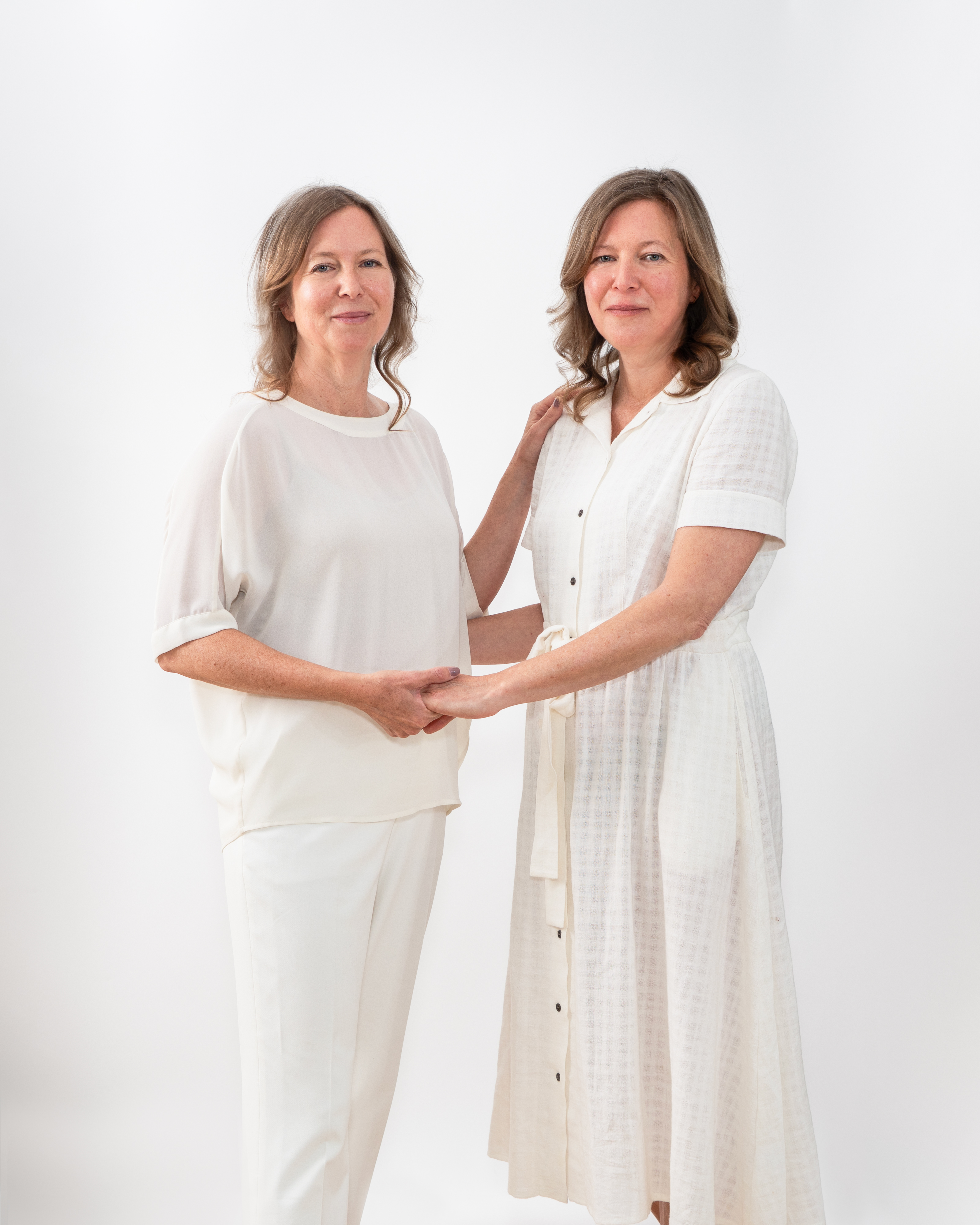
Photo credit: (left) Lonnie Stewart; (right) © Marge Rendell. Styling by Heather Greene.
Visit me on Substack to subscribe, thank you!