
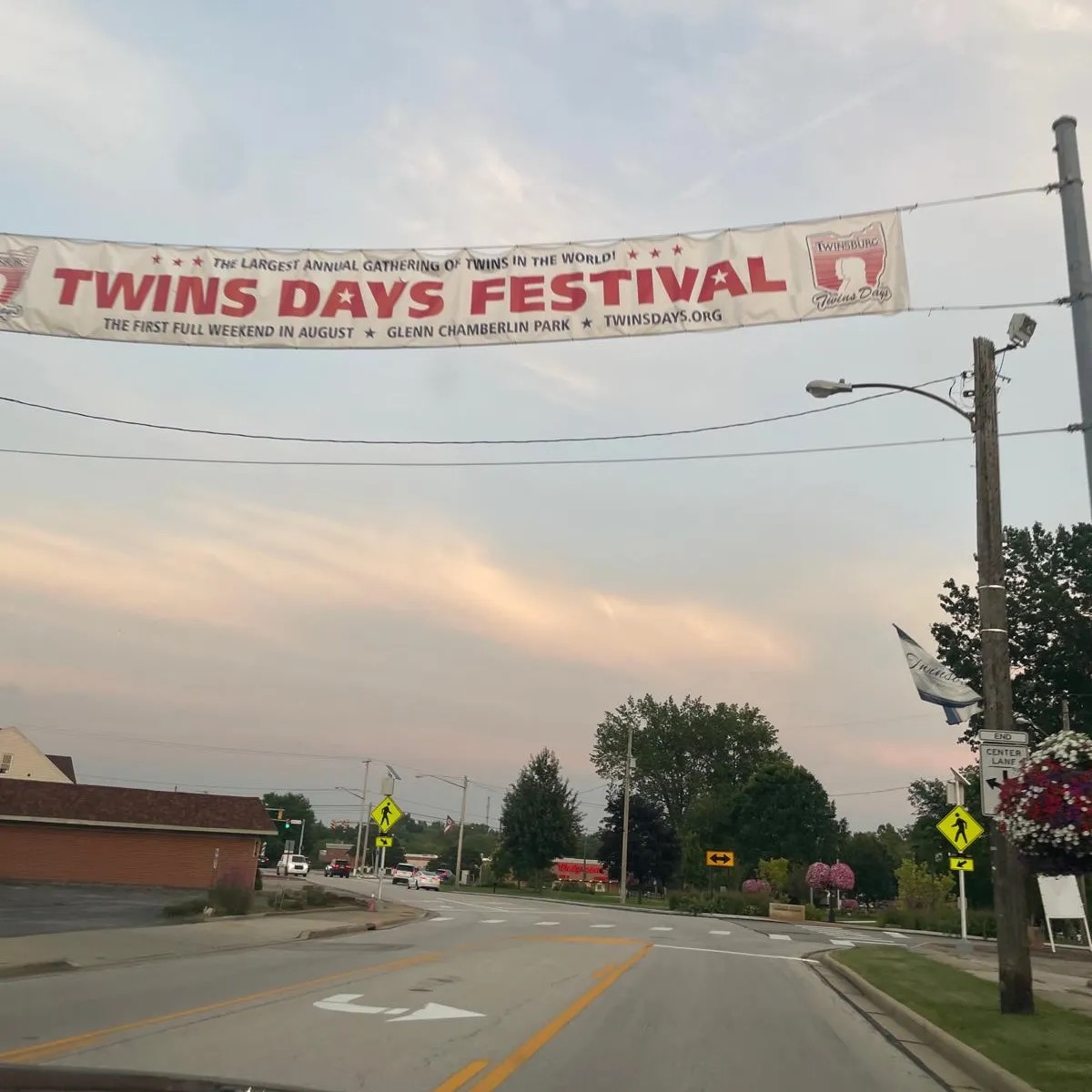
Multiples Multiplying
Twins. What a word. One immediately knows what “they” are and yet it’s ambiguous, isn’t it, who or what twins are. They live in another world, or at least that is one of the many ways I’ve heard them described. Twins are “fascinating,” is another. Especially the ones who look the most alike. One’s eyes skip back and forth, taking these identical humans in.
I am an identical twin. My sister lives in London now, far away from New York City, although really it’s not much farther away compared to where she lived before, in Los Angeles. We talk almost every day, and if we don’t speak, we text. If a few days pass between calls, there is the inevitable, “What did you do on Tuesday?” or, “Wait, you never told me what you did Thursday night.” It’s ongoing. It’s forever.
Last week, Karen flew to New York and the two of us set out Friday morning for the Twins Days Festival in Twinsburg, Ohio, the largest annual convention of twins in the world. It is also one of the only annual twin conventions, although it became clear over the weekend that twin conventions aren’t going anywhere. If anything, they just might multiply (we met a pair who organize a smaller annual gathering in the Bay Area called Twinner Time). First-timers to the festival, like Karen and me, became visibly ecstatic surrounded by so many other sets of twins. Questions like, “Is this your first year?” and “Will you come again?” kept popping up, which makes sense given the singularity of it all.
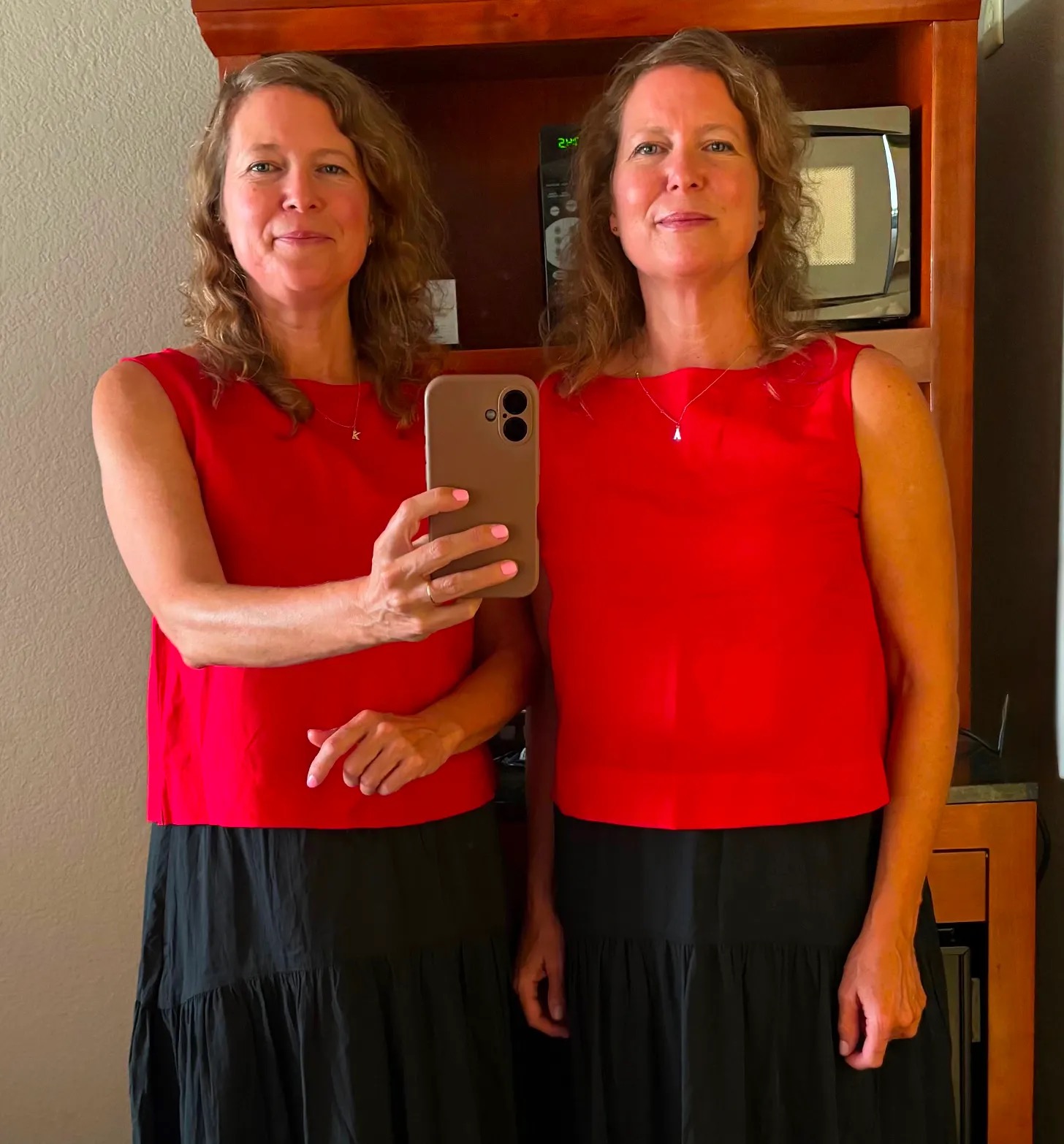
We felt nervous that first night, Friday, dressed in our identical red and black outfits with matching white flip-flops and headed to Twinsburg High School, where the first day’s events were held. We arrived after 7pm, and so the inauguration of the “Royal Court” had already taken place, as had other formalities and announcements. But maybe the slowly emptying gymnasium, where hundreds of twins had been seated in the bleachers just an hour before was a good thing for us, because even with half the people there (and thousands more coming the next day) this first immersion into a large room filled with identical twins dressed identically became doable, bite sized. It prepared us for what we would take in on Saturday. The atmosphere in that gym was bright and joyous, and as our eyes scanned the room, we couldn’t stop smiling. When a couple of twins struck up a conversation with us, both Karen and I had trouble focusing. We just kept looking around. We barely took photos.
The Mexican restaurant where we split a burrito overspilled with twins. The ushering-in we received, “Hi twins!”, “Welcome twins!”, emanated such undeniable warmth it was as if we’d stepped onto the set of a reality TV show. Not in a scary way, no, but in a way that said, “You’re here! You’re right where you’re supposed to be!” If ever there was a question whether my status as an identical twin has given me a life outside of the norm, a life the majority of the world does not experience, that question was put to rest that night. Every signal we got said, “Here you are the norm.” And by doing so, the feeling of acceptance only accentuated that deep-seated fact of our lives in the outside world (the world outside of Twinsburg, OH): You are different from us.
We pulled into the hotel parking lot after dinner and immediately saw the three firetrucks crammed crookedly up close to the entrance. Dozens of multiples milled around the parking area. We stood outside our car, exhausted and dizzy and not just from the eight-hour drive from Brooklyn. Off to our right stood a set of identical twins dressed in identical pajamas and ensconced in conversation. A woman sat in a wheelchair against the curb behind them. For a second I wondered if they wouldn’t want us to interrupt. But the instant we approached and asked, “Do you guys know what’s going on?” the two (Danielle and Christina Leccese from New Jersey, we would soon learn) immediately filled us in. A fire alarm went off around 9pm, just as they’d gotten their mother (the woman in the wheelchair) into bed. “It’s going to be a while because they were handing out water bottles,” Danielle said.
I’m so happy she was right. We talked to Danielle and Christina for the following forty-five minutes. We told each other our life details, where we lived (they live together in New Jersey), what we did for a living (they are both executive assistants in larger corporations), how we had come to Twins Days and why (the reasons themselves were identical: we always wanted to go, just finally making it happen this year). Danielle and Christina are particularly identical, almost astonishingly so. We would meet many other sets like this the following day, but since this was the first pair of such identical twins we came across it was impossible not to do the thing that people always do to Karen and me, or that they used to do when we were younger and still living together. My eyes went back and forth from one face to the other, and the experience of seeing the “same” face side by side, living, breathing human bodies that look essentially exactly alike, is extraordinary. It almost never happens.
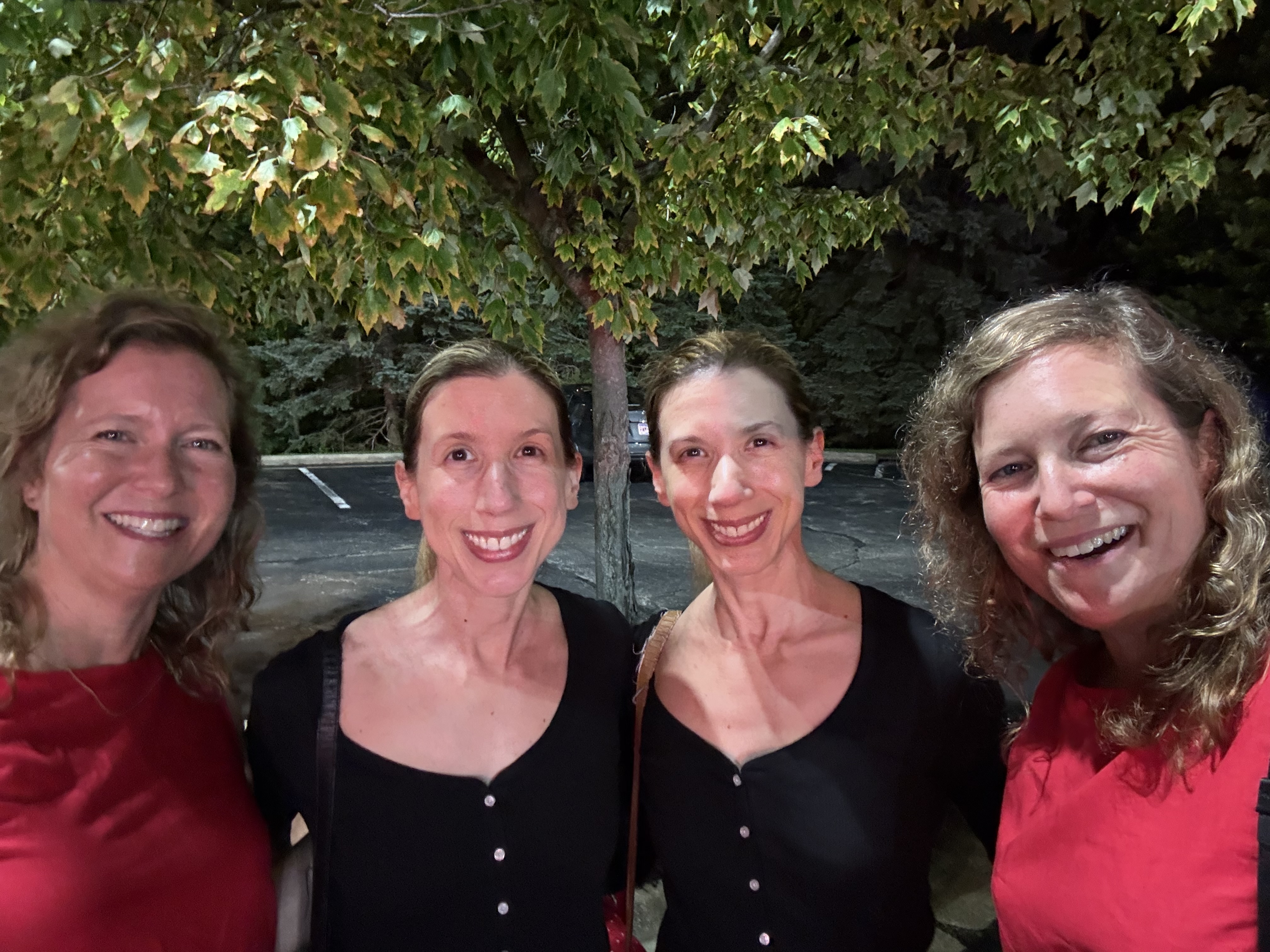
With Danielle and Christina in Twinsburg.
This encounter prepared us well for Saturday, as we headed into the thick of the Twins Days Parade launching from Township Square at precisely 9am and ending in Glen Chamberlin Park, where the festival would take place. Twinsburg has a population of about 20,000 and sits twenty-five miles southeast of Cleveland. First called Milltown, identical twin brothers Aaron and Moses Wilcox bought 4,000 acres in 1818 and donated parcels as well as a school in exchange for renaming the settlement Twinsburg. Almost ten years later, they would die on the same day, that’s how close the brothers were. Yet two hundred years later, as the convention got underway—the Twins Days Festival is now in its 51st year—I couldn’t escape the sensation that this place truly was haunted by twins. Both in the fact that twins from all over the world (Japan, Nigeria, Iceland, Sweden, Canada, England, and on and on) have descended upon this tiny town every year, but also in the fact that it has housed rivers of twins over decades, each year bringing new twins, replacing any who have moved on.
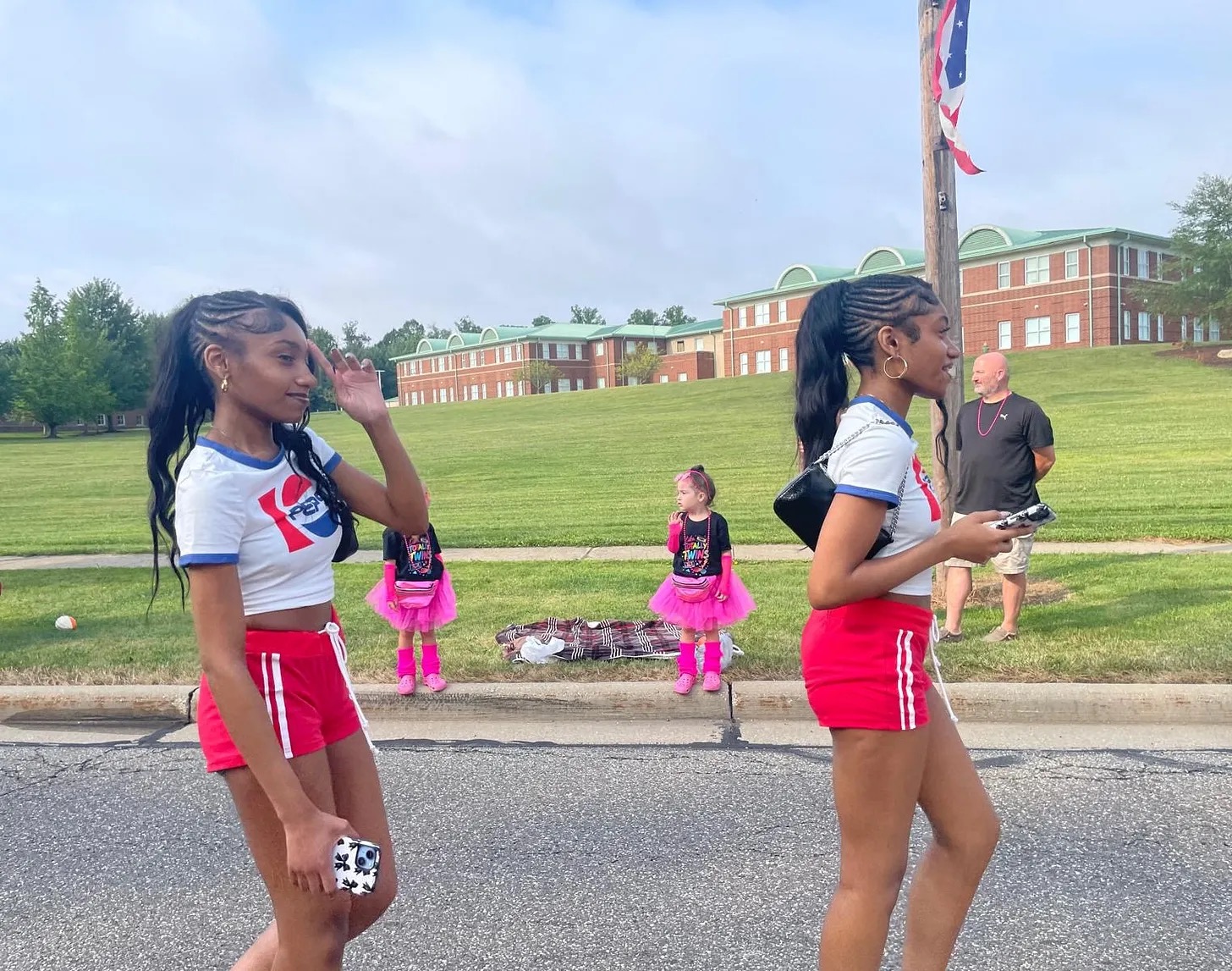
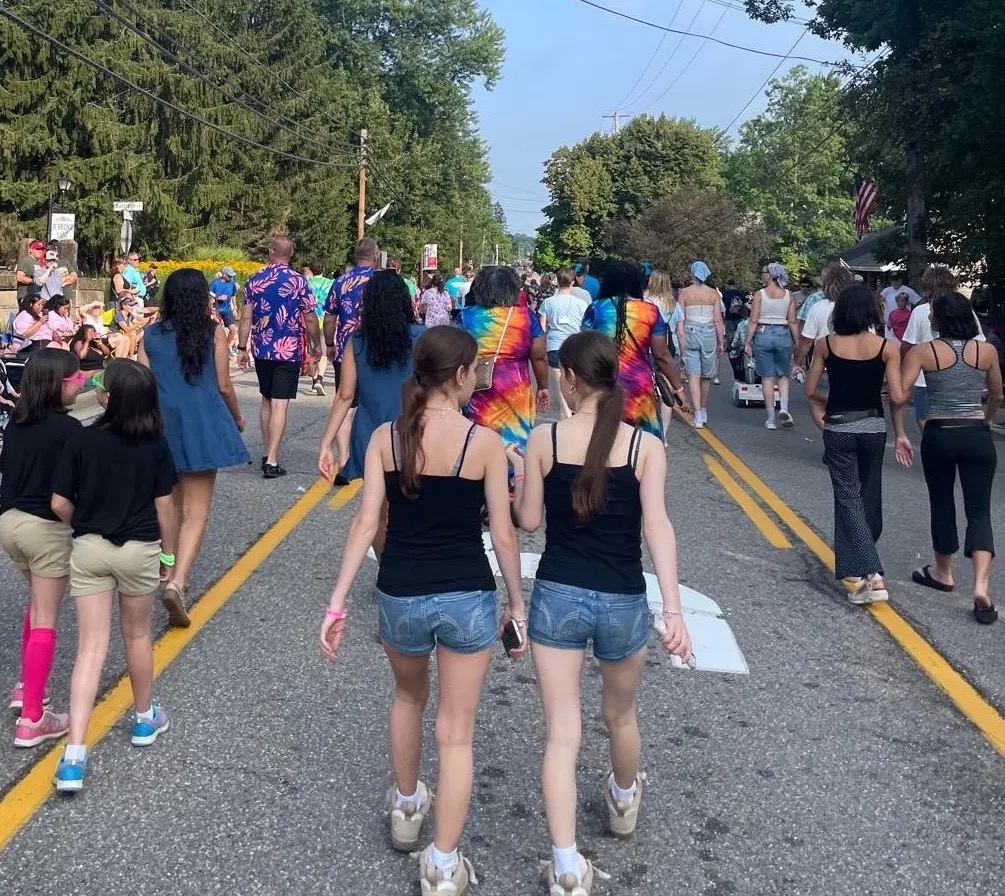
The annual Twins Days Parade.
More than 2,000 sets of twins walked the streets of Twinsburg over the course of the weekend, which makes more than 5,000 people who were born twins. We saw triplets and quadruplets. We saw hundreds and hundreds of pairs of identical twins young and old. People in their nineties. Identical babies strapped in carriers to their parents’ chests.
Saturday was hot. That early-August Midwestern sun can only do one thing, and that is burn down on you, forcing sunglasses and hats and respites in the shade. Once again, Karen and I got lucky in the long line for commemorative portrait buttons. It was early in the day so we thought we might as well get it done with. The registration lines outside the entrance to the park were hundreds of yards long; the portrait line would only grow. And it just so happened that the twins ahead of us, Julie and Abby Wolf, were exactly who we were supposed to meet. Among the many coincidences between us was the fact that Julie is an editor (we share work experience) and Abby is an art historian (Karen and she know curators in common). Abby’s daughter graduated from Smith College, my alma mater, and Julie’s family would attend a library horror event in their town outside of Boston that evening (I have just written a horror novel). We talked for the entire two hours we stood in line. Later we shared a ride to the party at the Bertram Inn.
These bonds are unlike other acquaintance bonds. In them is so much more than the surface details of what someone does for a living and where someone lives. They include deep dives into how one grew up, how one survived as an identical twin, and how one survives today, whether living together, nearby, or apart. Of all the twins we met at the festival, Karen and I were one of the few sets who lived in different cities. The overwhelming majority of twins at Twins Days lived near to each other—if not in the same house or apartment as their twin then in the same location.
Julie pointed out something Karen and I had been thinking to ourselves, which was how new it was to see identical brothers everywhere. Men who strode quietly side by side, as close together as the female twins. I mainly know female identical twins, and so the brothers I saw almost moved me to tears. Julie mentioned she had asked one set about empathy, since it’s often assumed normal for women to show affection with each other, to do things together, and keep close. Men are more often assumed to be stoic, independent. She had a theory—a correct one, I think—that identical men would have grown up caring about someone other than themselves and therefore have a better sense of empathy, a trait categorically attributed to, and sometimes forced upon, women.
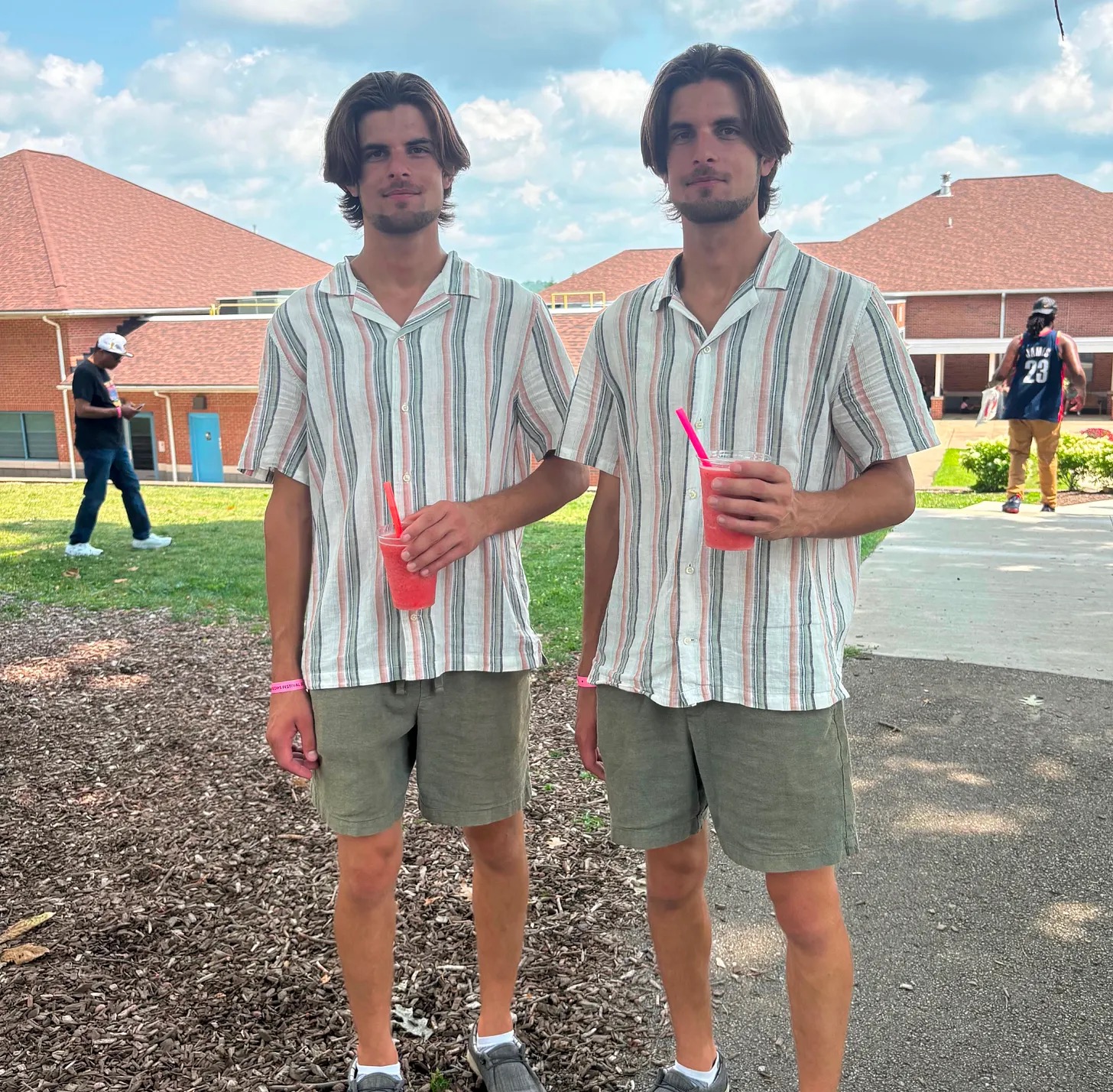
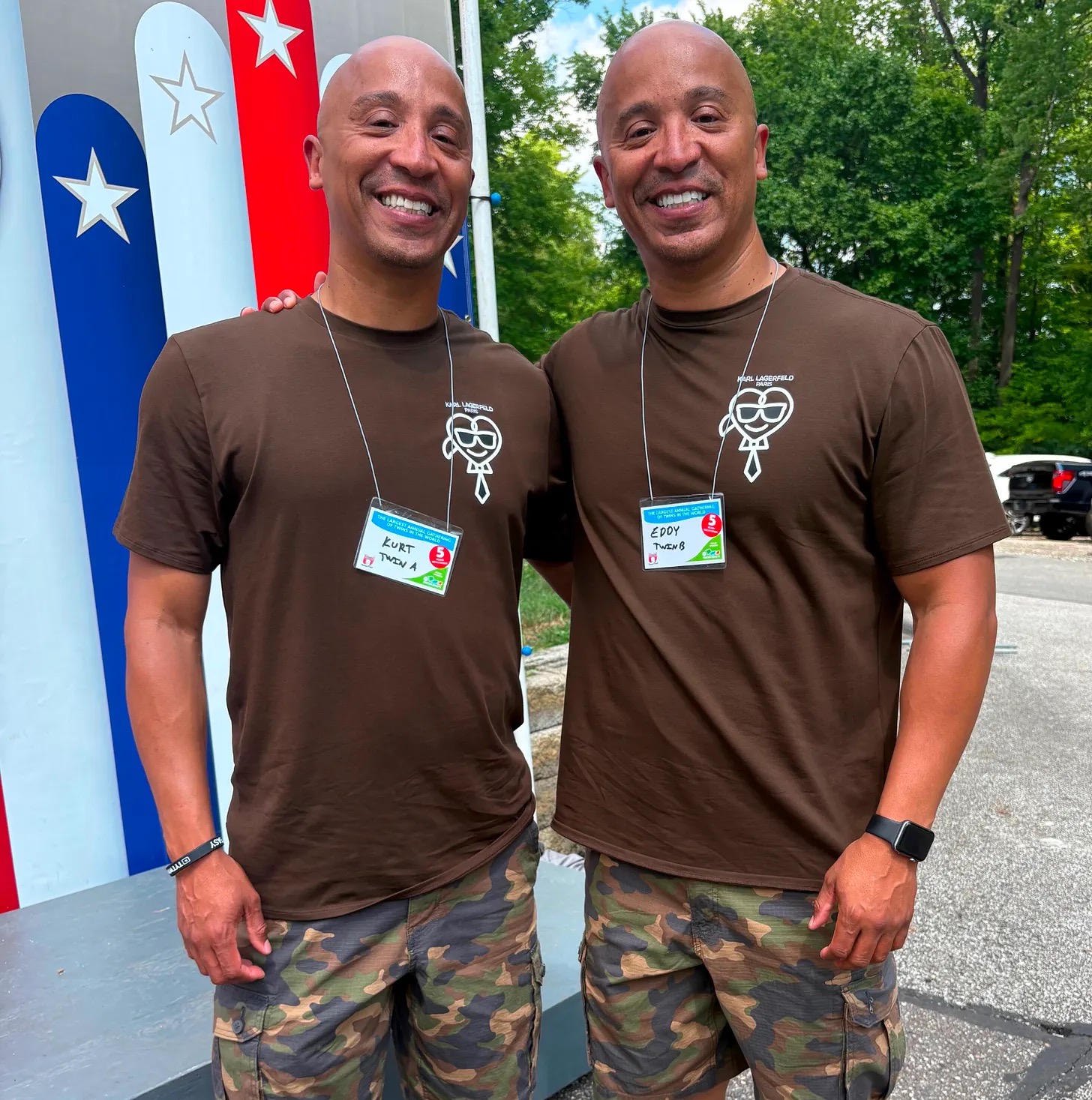
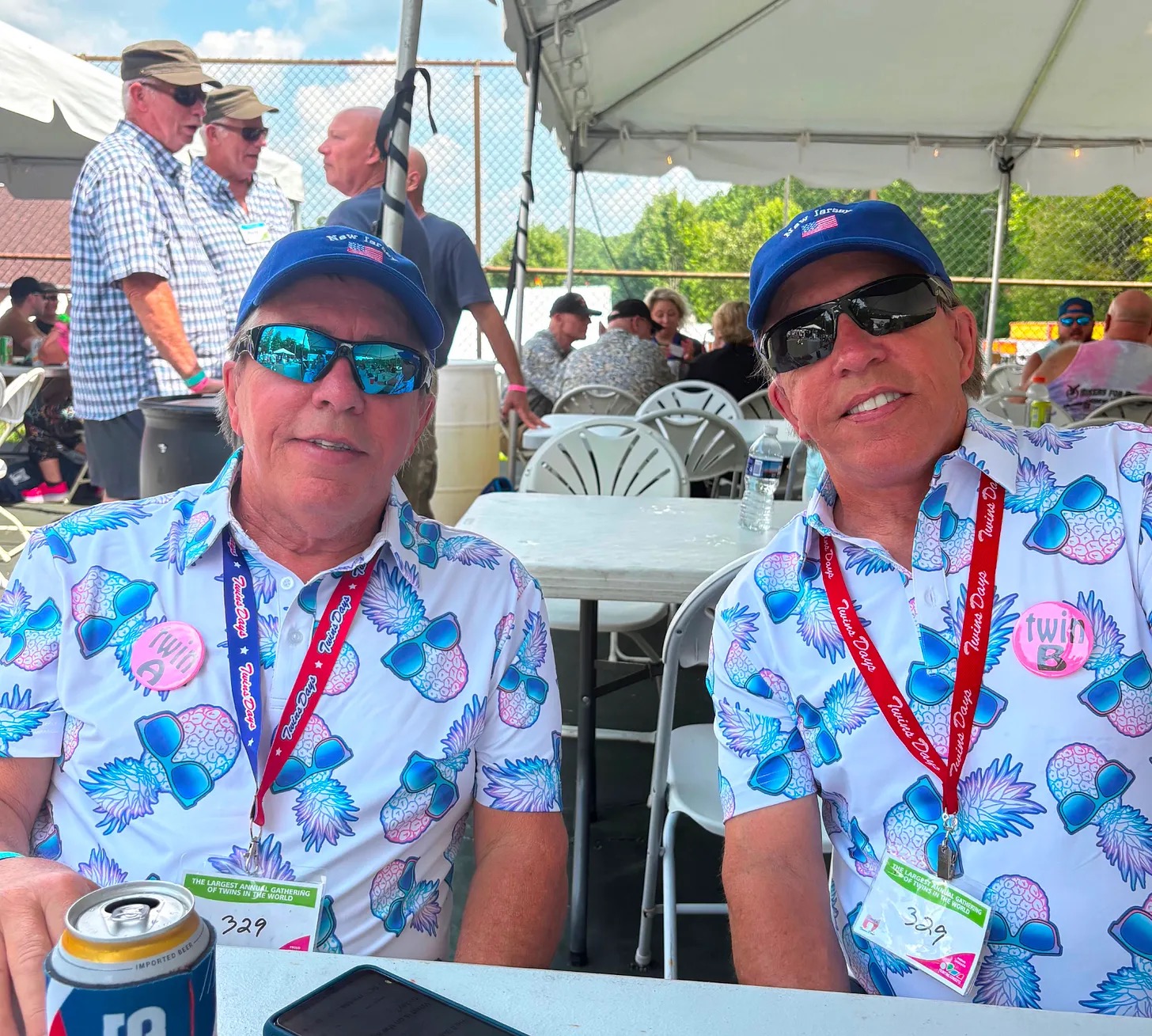
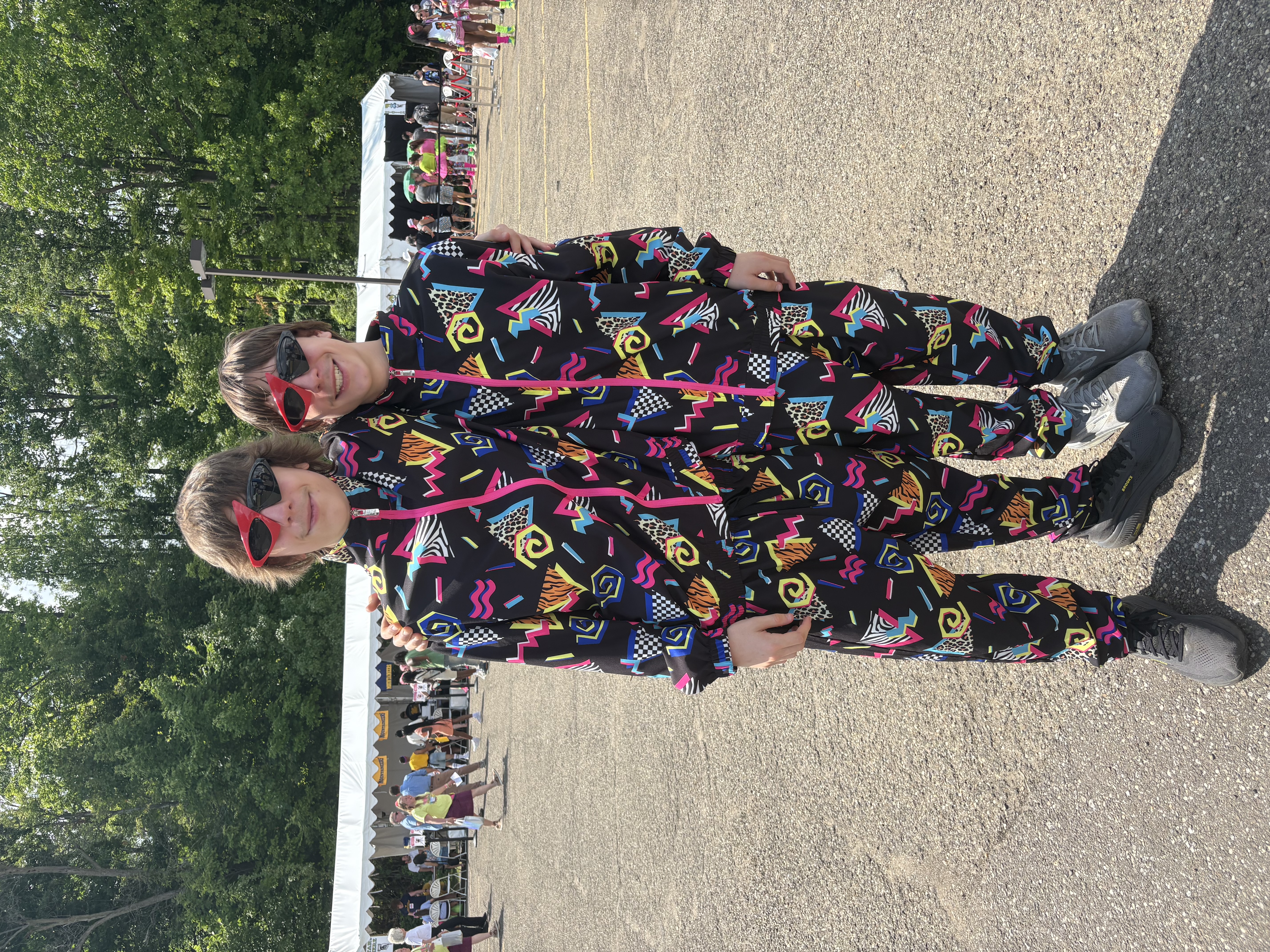
As the day went on, the essence of caring for others became as palpable as the thick hot air around us. This feeling of kindness, of welcome, of opening doors for others pervaded late into the evening, when everyone gathered at The Bertram a few miles outside of Twinsburg for the big Twins Days afterparty. People had changed into dresses and suits, and all were there to dance and drink and mill around. Karen and I mostly observed, but we also danced and talked to many sets of twins, raising our voices above the pop music. One sister in a set who were dressed all in black like we were pronounced, “Isn’t this INSANE?!?” “YES!” we agreed. Then her sister (they were another remarkably identical pair who live together in New York City) exclaimed, “No one gets this!! No one in a million years who isn’t a twin would understand how INSANE this is!!” We all laughed. It had been a day of this, and yet, close to midnight, we were still marveling, soaking it up, breathing it in. Multiples everywhere, multiplying. We were, finally, in a place where others understood us.
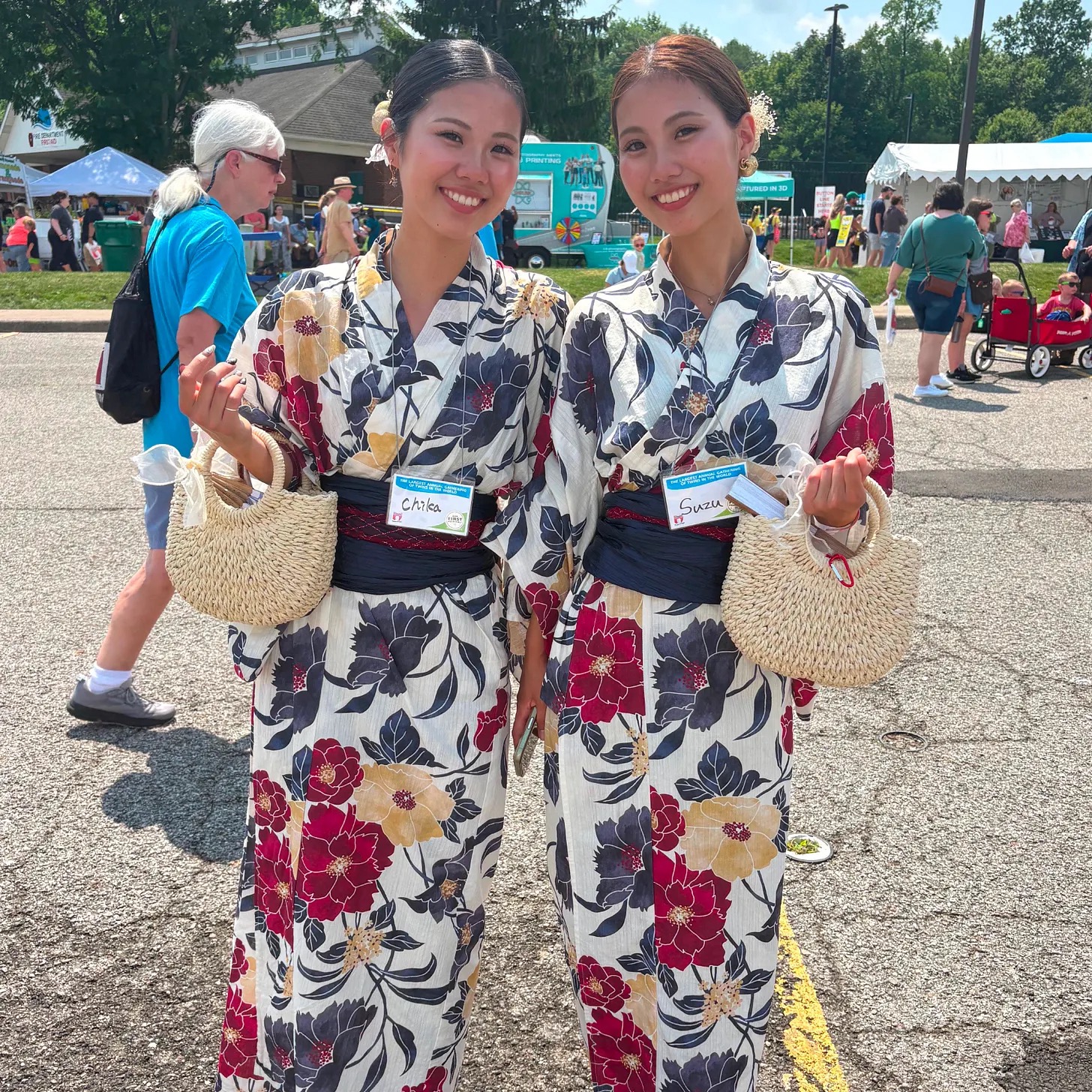
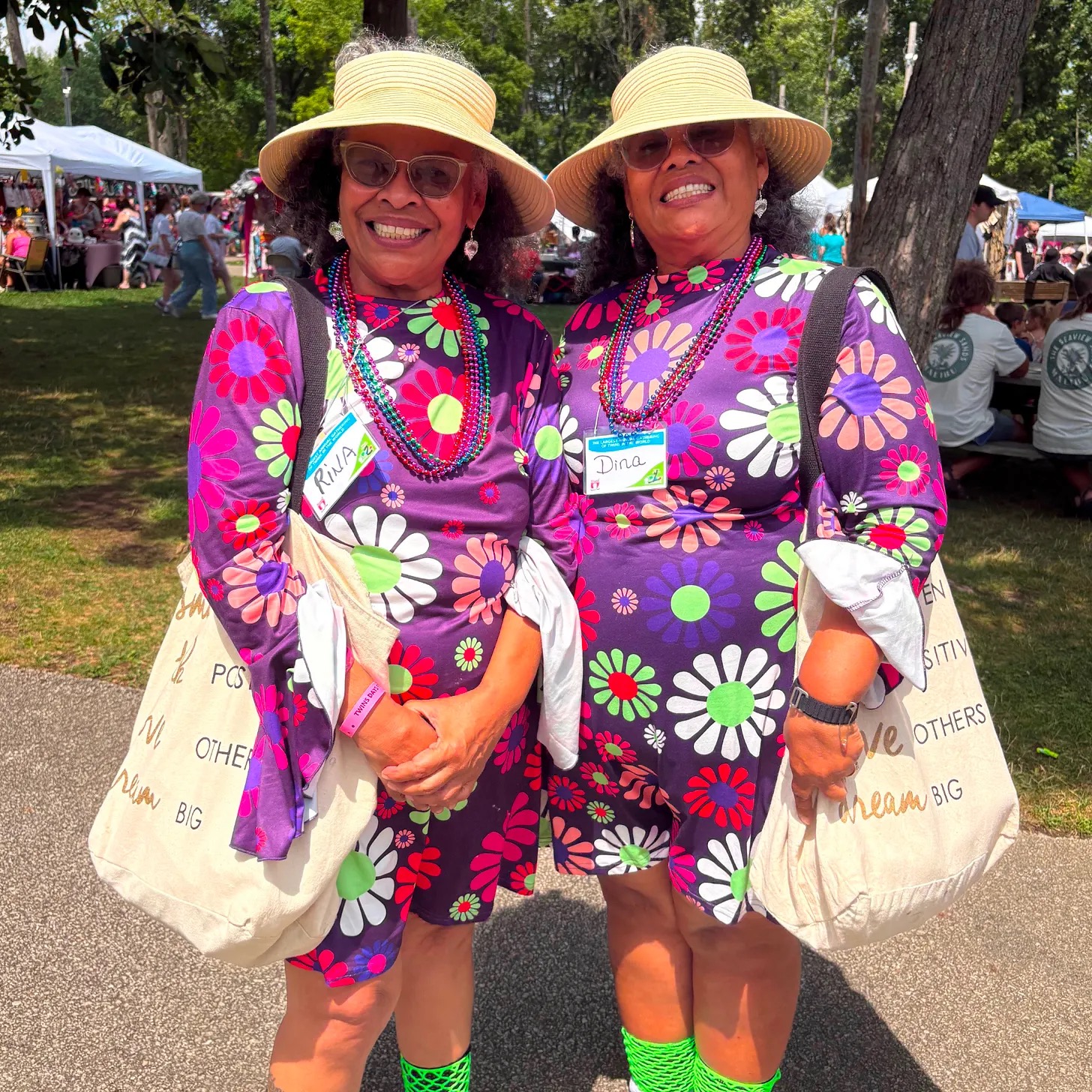
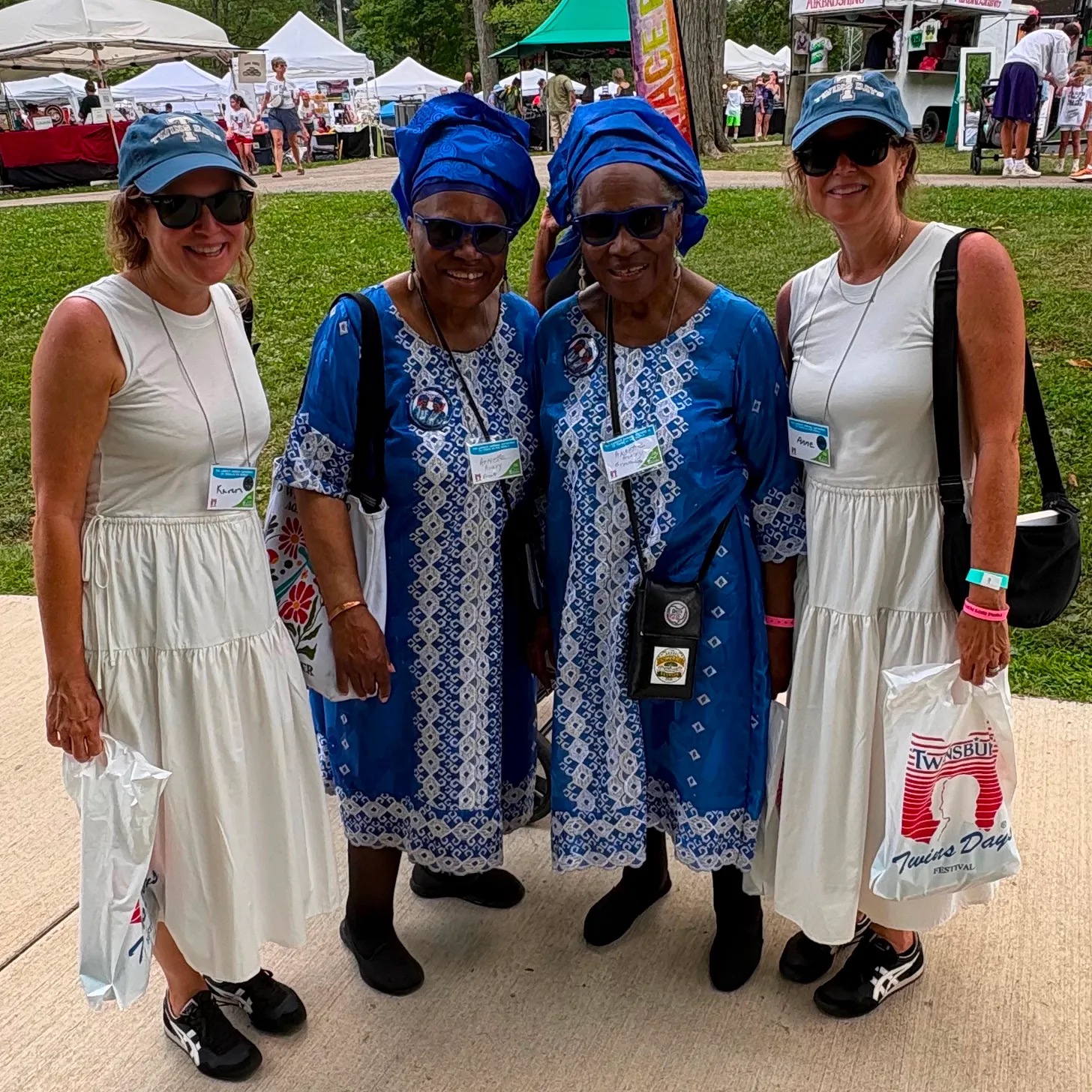
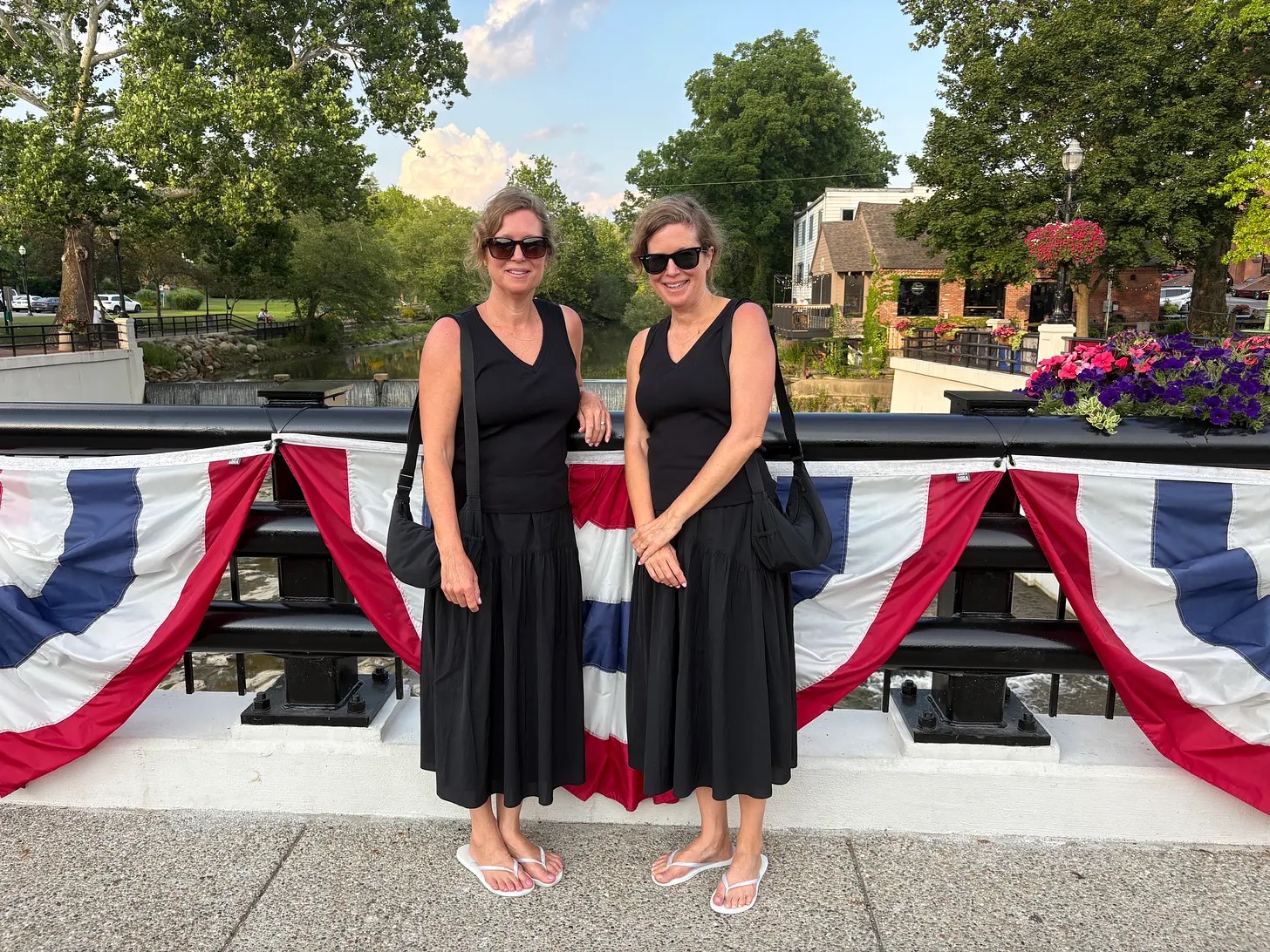
Something happened during the weekend that brought all of this into focus. Before the party on Saturday night, Karen and I stole away just the two of us to Chagrin Falls for dinner. We drove about ten miles until we came upon this idyllic town, perched on a quiet river with a bridge over its titular waterfall. The night turned golden and the town buzzed with tourists out and about, taking in the sunset, getting ice cream, the heat of the day pleasant now, a salve for the lungs and the skin. Karen and I stopped on the bridge to take a selfie. We were dressed identically in black tank tops and skirts, our white flip flops. I wore my “A” gold chain necklace and Karen wore her “K” chain. Just as we were setting ourselves up, a woman passing by with her husband asked if we wanted her to take the photo. She did, and then inevitably, as she gave the phone back to me, asked, “Are you twins?”
It is almost impossible to describe the jolt this question caused inside of us, after twenty-four hours in the Twinsburg bubble. In Twinsburg, no one asked this question. No one stood outside of our twosome and looked “in” on us. In Twinsburg, people approached us and we approached them. We pulled ourselves up to each other, talked, and grew closer. There was no need for a question that separated us, one couple from the other. When the woman asked her question, which was a perfectly normal question to ask, it was again that stark reminder that we are different from the majority after all.
We walked on to the restaurant and saw that not a single other pair of twins walked alongside us. As we ate, it became obvious we were the only twins eating at the restaurant that night. At the Twins Days Festival, what had become normal, even if for a matter of hours, was that to be a twin, to walk around in this world in parallel with someone who looks just like you, was not a dream. It was not an anomaly. It was not a freak accident of Nature. It was life, all of our lives, Karen’s and mine and every other twin’s—a normal life.
As soon as we paid the tip we got back in our car and drove to Twinsburg for the fireworks and dance party. We didn’t have to say it out loud. That we were glad to be going back to the place where all the twins were, at least for a few more hours.
We even hurried.
All photos © Anne and Karen
Visit me on Substack to subscribe for free, thank you!